Hardwood vs. Laminate Basement Flooring: Moisture Risk, Costs, and Lifespan
If you are weighing hardwood vs laminate basement flooring choices for a St. Louis home, the honest starting point is this: the slab under your feet matters more than the plank you pick. Hardwood and laminate both deliver the wood look most homeowners want for a finished basement. They behave differently below grade, they cost differently over ten years, and one of them fails in ways the other usually does not. This guide compares the two head to head, grounded in what St. Louis slabs and humidity actually do to wood-look floors.
Here is the short version before we get into the details. Solid hardwood is a poor fit for most basements, full stop. Engineered hardwood can work on a dry, well-prepped slab with the right subfloor. Laminate handles basement conditions better than real wood but still needs moisture protection underneath. If your basement has any history of water, luxury vinyl plank often beats both. The rest of this article explains why, so you can match the material to your actual conditions instead of a showroom display.
Why Basements Punish Wood Floors in the First Place
Concrete looks solid, but it moves moisture. Ground water vapor migrates up through a slab continuously, even in a basement that has never flooded. A vapor barrier placed over the base course under a concrete slab is meant to block moisture transmission from the ground into the concrete above, according to W. R. Meadows. The problem is that many St. Louis homes, especially those built before modern practices, either have no vapor barrier under the slab or have one that was damaged during the pour.
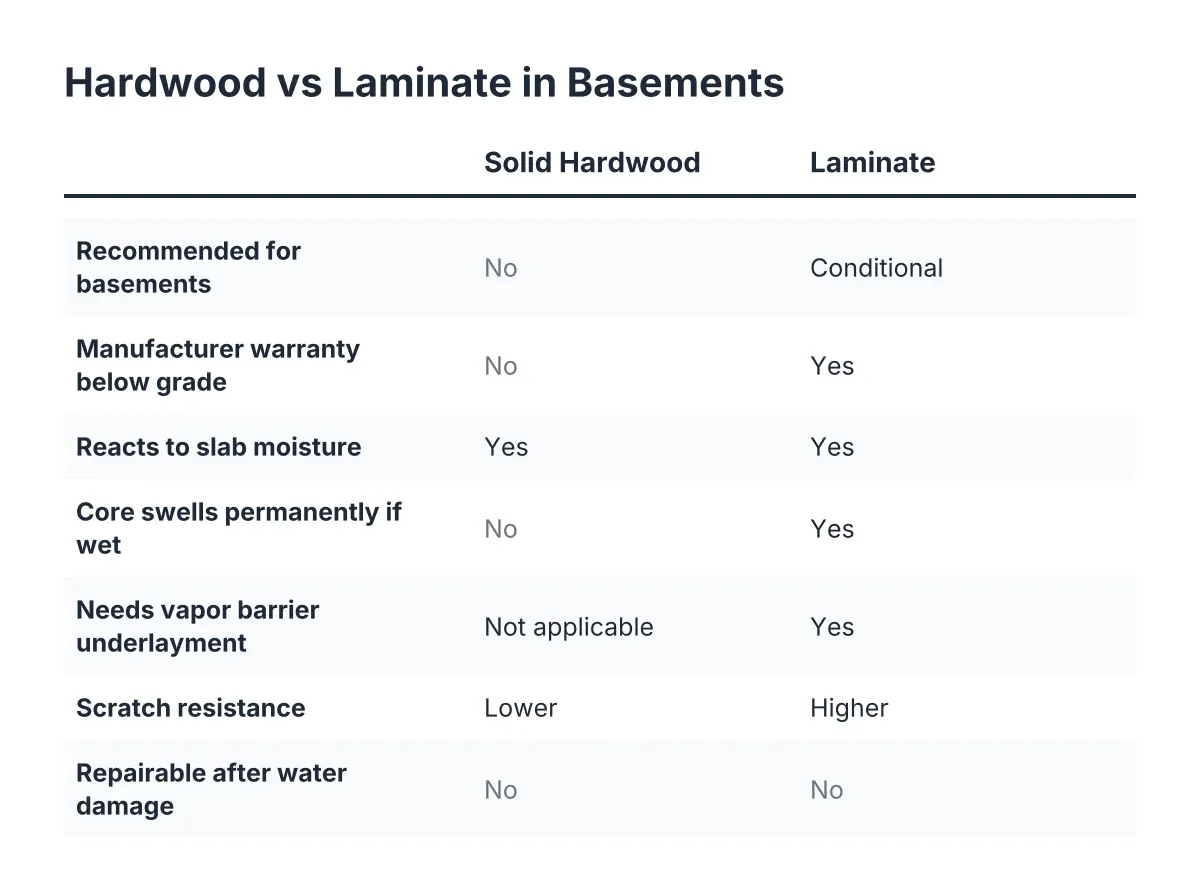
Wood and wood-based products react to that moisture. Solid hardwood absorbs vapor, swells across the grain, and cups or buckles. Laminate's fiberboard core swells at the edges when water reaches it, and swollen laminate does not shrink back. Neither failure is repairable in place; you replace the damaged boards or the whole floor.
In addition, St. Louis adds a seasonal humidity swing on top of slab moisture. Summers here push basement humidity high enough that wood flooring expands even without a wet slab. Winters dry everything back out. That annual cycle stresses wood floors in a way a first-floor install never experiences. Any wood-look floor going into a basement here needs to be judged against that cycle, not against how it performs in a climate-controlled showroom.
Hardwood in the Basement: Where It Works and Where It Fails
Start by splitting hardwood into two different products, because they behave differently below grade.
Solid Hardwood vs. Laminate in Basement Conditions: Almost Never the Right Call
Solid hardwood planks, the three-quarter-inch boards nailed to a wood subfloor, are the wrong product for a basement in nearly every case. The planks are milled from a single piece of wood, so they expand and contract with every humidity swing. Below grade, with vapor coming up through the slab and St. Louis summer humidity in the air, solid wood cups, gaps, and buckles. Most manufacturers void their warranties for below-grade installation, which tells you what they expect to happen.
The one exception is a fully conditioned basement with a verified dry slab, a plywood subfloor system, and year-round humidity control. Even then, you are accepting risk that a first-floor install never carries. For most homeowners, the look is not worth the exposure.
Engineered Hardwood: Real Wood, Managed Risk
Engineered hardwood changes the math. A thin veneer of real wood sits on a plywood or composite core built in cross-layered plies, which resists the expansion that wrecks solid planks. Many engineered products are rated for below-grade installation when the slab tests dry and the floor goes over a proper moisture barrier or raised subfloor.
Engineered hardwood gives you a genuine wood surface that can be lightly refinished once or twice, depending on veneer thickness. It reads as real wood underfoot and to the eye, because it is. For the homeowner planning a basement bar where guests will notice the floor, that authenticity matters.
However, engineered hardwood is still wood on top. Spill a drink and wipe it up, no problem. Let a water heater leak sit overnight, and the floor is likely done. It is also the most expensive wood-look option in most basement flooring cost comparisons, both in material and in the slab prep it demands.
How Laminate Flooring Handles a Concrete Basement Floor
Laminate flooring performs better in basements than real wood, provided the slab tests dry and the install includes a vapor barrier underlayment. The photographic wear layer shrugs off scratches and sunlight, and the click-lock planks float over concrete without nails or glue. The weakness is the fiberboard core, which swells permanently if standing water reaches it.
That core is the whole story with laminate. The top layer is tough; many laminates resist scratches better than hardwood, which matters if the basement doubles as a kids' play zone or a high-traffic bar area. The core underneath is compressed wood fiber, and wood fiber plus water equals swollen edges and peaking seams.
Therefore, three things decide whether laminate succeeds over your concrete:
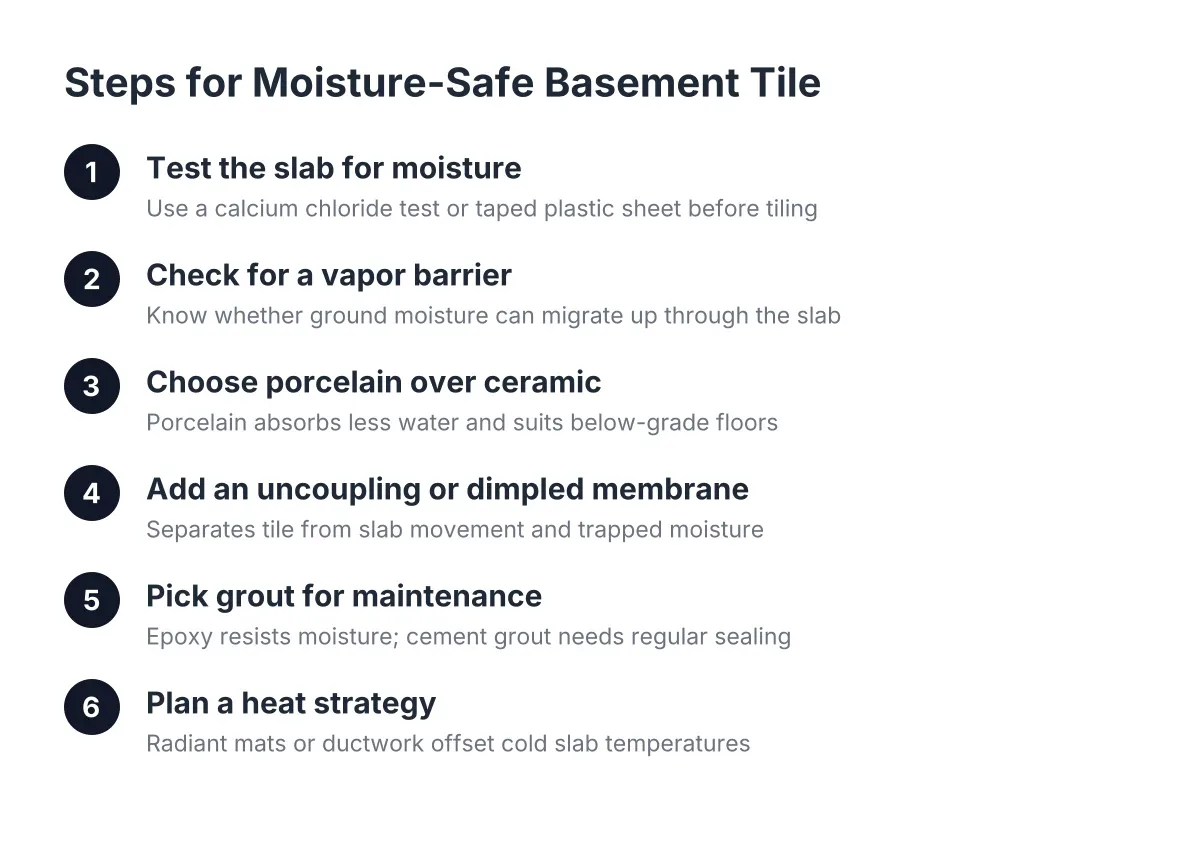
- Slab moisture testing before install. A calcium chloride test or relative humidity probe tells you what the slab is actually emitting. Skipping this step is how most basement laminate failures start.
- A true vapor barrier underlayment. Even laminate with pre-attached padding needs a dedicated moisture layer over concrete. The attached pad cushions; it does not block vapor.
- Water-resistant core products. As of 2026, several manufacturers sell laminate with cores engineered to resist swelling for a stated number of hours of surface water exposure. These are meaningfully better below grade than standard laminate, though "water-resistant" still does not mean waterproof.
For example, say a homeowner in Kirkwood just closed on a 1970s ranch with an unfinished basement and wants it done before furniture arrives. The slab tests dry, there is no history of seepage, and the budget needs to cover framing, a bathroom rough-in, and flooring. In that scenario, a water-resistant laminate over a quality vapor underlayment is a defensible choice that leaves budget for the rest of the project. If that same slab had shown elevated moisture readings, the recommendation would flip to luxury vinyl plank or tile without hesitation.
Hardwood vs. Laminate Basement Flooring Costs Over Ten Years
Comparing hardwood and laminate basement flooring on price means looking past the per-box sticker to what each floor demands over a decade below grade. Laminate costs less upfront in material and prep. Engineered hardwood costs more at every stage but can be refinished instead of replaced. The deciding variable is moisture risk, because a single water event resets the clock on either floor.
Rather than quote per-square-foot figures that shift with product lines and market conditions, here is what actually drives the cost gap between the two:
- Material tier. Engineered hardwood material generally runs well above laminate for comparable looks. Thicker veneers that allow refinishing cost more still.
- Slab preparation. Engineered hardwood demands a flatter, drier slab. Grinding high spots, filling low spots, and adding a moisture mitigation layer or plywood subfloor adds real cost that laminate installs sometimes avoid.
- Underlayment. Both need a vapor barrier over concrete. Hardwood systems often require more robust moisture protection, sometimes a full raised subfloor.
- Repair after a water event. Swollen laminate planks get replaced; a floating floor makes partial replacement feasible if you kept spare boxes. Water-damaged engineered hardwood usually means a larger tear-out.
- Lifespan and refinishing. Laminate cannot be refinished. When the wear layer goes, the floor goes. Engineered hardwood with a decent veneer can take a light refinish, extending its life past laminate's.
As a rough illustrative estimate, a homeowner finishing a 700-square-foot basement might see the flooring line item land 40 to 80 percent higher with engineered hardwood than with mid-grade laminate once prep is included. Treat that as a framing number, not a quote; your slab condition and product selection move it in both directions. A contractor who tests your slab first can give you a real number instead of a range.
The resale angle matters too, especially for a recent buyer thinking about long-term value. Basements generally return less of their renovation cost than main-floor work unless the finish level is high throughout. That argues against stretching for premium hardwood in the basement while cutting corners elsewhere, and for putting the savings into things guests notice, like the bar build or a basement bathroom.
What a St. Louis Slab Check Should Tell You Before You Choose
Choosing between these two floors before anyone has looked at your slab is guessing. Across St. Louis homes, the slab conditions that decide this choice fall into recognizable patterns, and a basement-focused contractor checks for them before recommending anything.
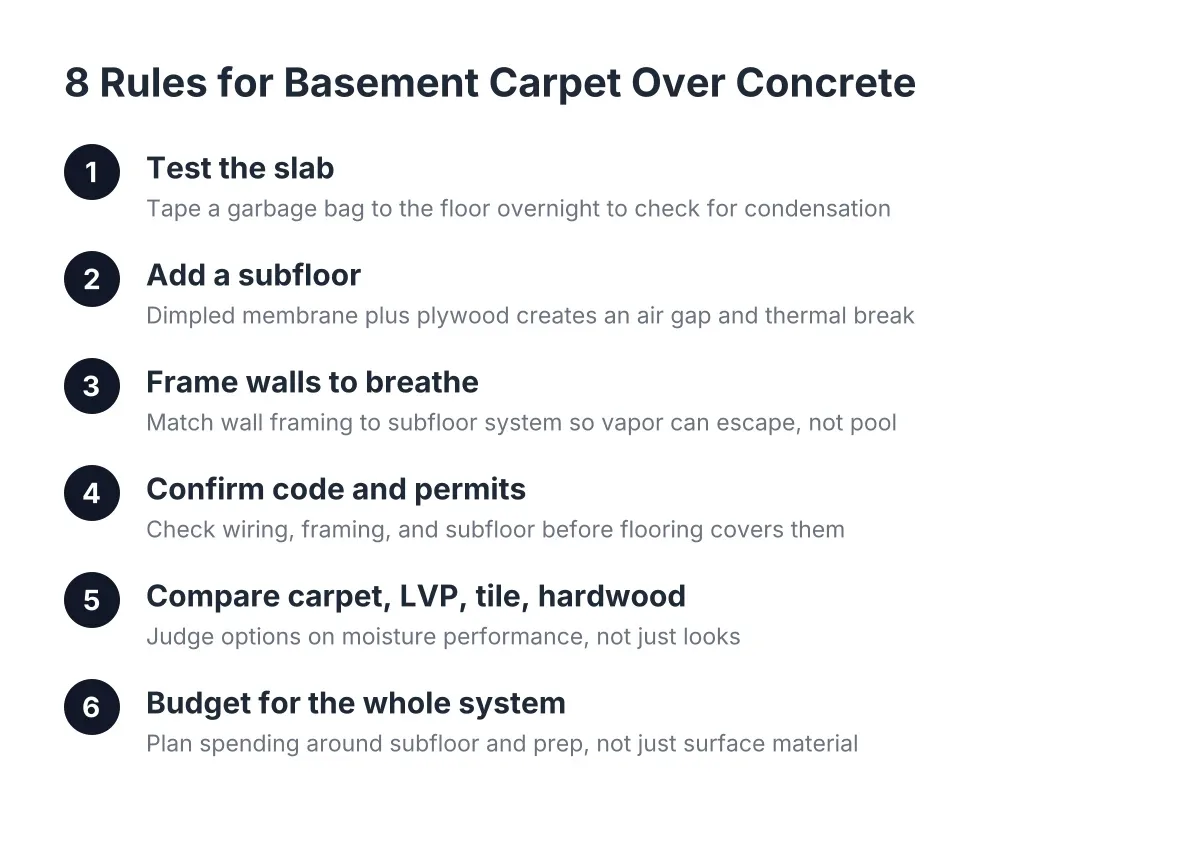
First, the age of the home signals vapor barrier odds. Newer construction likely has plastic sheeting under the slab. Older city and inner-suburb homes often do not, which raises baseline vapor emission. Either way, even a basement with a vapor barrier under the slab benefits from a subfloor system over it, because the barrier protects against routine vapor, not against a plumbing failure or a hundred-year rain.
Next, the slab itself gets read. Efflorescence, the white mineral haze on concrete, means water has been moving through it. Dark patches after heavy rain mean active seepage. Blisters in the original concrete surface can point to trapped air from finishing problems or a vapor barrier that kept water from absorbing into the subgrade, according to NRMCA; they also create flatness issues a floating floor will telegraph.
Then comes actual moisture testing, not a guess based on how the floor looks in July. A dry-looking slab in winter can emit heavy vapor in summer. This is the step that separates a floor that lasts fifteen years from one that peaks at the seams in eighteen months.
Finally, the subfloor decision. For either hardwood or laminate, a plywood subfloor over a raised moisture-barrier panel system adds warmth, a thermal break from the cold slab, and a drainage plane if water ever gets in. It raises the floor height, which matters in low basements, and it adds cost. On a dry slab with laminate, you can sometimes skip it; with engineered hardwood, it is usually the difference between a safe install and a gamble. Any framing that lands on the slab alongside the floor, like bar walls or partition walls, should sit on pressure-treated bottom plates for the same moisture reasons.
One honest limitation: if your basement has flooded before, or floods during the kind of storms St. Louis gets every few summers, neither hardwood nor laminate is the right answer no matter how good the prep is. Fix the water problem first, or choose a floor that survives getting wet.
When Neither Wood nor Laminate Is the Answer
Some basements disqualify both options, and it is better to know that before you fall in love with a plank sample. If the slab tests wet, if there is seepage history, or if the budget cannot cover proper moisture prep, step sideways to materials built for those conditions.
Luxury vinyl plank is the usual landing spot. LVP resists humidity and moisture and does not cup or buckle the way wood flooring can, and modern lines mimic hardwood convincingly enough that most guests at your basement bar will never check. It still should not go straight onto bare concrete; moisture migrating through the slab can get trapped underneath, so a moisture-protective underlayment stays mandatory even when planks ship with padding attached. Among waterproof basement flooring options, LVP gives you the wood look with none of the swelling risk.
Carpet fills a different role. For a basement zone meant as a kids' play area, carpet is close to essential for comfort and safety, and it tames the echo that hard floors create in a finished basement. Nylon carpet for basement use holds up better to traffic and moisture events than cheaper fibers, and waterproof carpet tiles for basement installs let you pull and replace individual squares after a spill. Some homeowners even run peel and stick carpet tiles 24×24 in a playroom corner while putting laminate under the bar. Mixing basement flooring options by zone, hard surface at the bar and soft surface in the lounge or play area, often beats forcing one material across the whole level.
Tile deserves a mention for basement bathroom floors and wet bar zones, where it outlasts everything else. It is cold and hard underfoot, so most homeowners limit it to those wet areas rather than running it wall to wall.
Making the Call: A Practical Decision Path
Pull the comparison together and the decision tree for hardwood versus laminate basement flooring gets short.
Choose engineered hardwood when the slab tests dry, the budget supports full moisture prep and a subfloor, and the authentic wood surface is a priority, for instance under a showpiece basement bar you intend to photograph and show off. Skip solid hardwood below grade entirely.
Choose laminate when you want the wood look at a lower cost per square foot, the slab tests dry, and you commit to a vapor barrier underlayment and a water-resistant core product. Keep a spare box of planks for future repairs.
Choose LVP or tile when the slab shows moisture, the basement has any flood or seepage history, or you want to stop thinking about water altogether. Choose carpet, nylon or in tile form, for comfort zones and play areas.
Two last practical notes. Lighter floor colors hide dust and brighten a space that gets limited natural light, which is why they tend to look cleaner in basements over time. And before any flooring goes down, confirm whether your project scope triggers a permit; flooring alone usually does not, but the framing, electrical, and plumbing that come with a full basement finishing project in St. Louis typically do, and the flooring install should be sequenced after that inspected work, not before.
If your slab condition is unclear, or your basement sits in a neighborhood known for water tables that rise with the Mississippi and Missouri, have a contractor run moisture testing before you order a single box. The test costs little against the price of replacing a swollen floor, and it turns this whole hardwood versus laminate basement question from a guess into a straightforward answer.
If you need basement finishing, STL Basement Finishing can help.
Prefer to talk it through? Call (314) 916-6297 — a quick call is usually the fastest way to get a straight answer for your situation.